
ICD-10-CM AND THE EMERGENCY PHYSICIAN
|
|
|
- Bennett Lawson
- 10 years ago
- Views:
Transcription
1 ICD-10-CM AND THE EMERGENCY PHYSICIAN BACKGROUND Technically known as the International Statistical Classification of Diseases and Related Health Problems, the International Classification of Diseases (ICD) is the standard tool for epidemiologic tracking of illnesses and injuries as well as morbidity vital statistics. A copyrighted publication of the World Health Organization (WHO), it is part of the WHO family of international classifications. This includes the International Classification of Functioning, Disability and Health, the International Classification of Health Interventions, and the International Classification of Diseases for Oncology. An attempt to develop a single uniform mortality classification system was made at the first International Statistical Congress (ISI) in The ISI in 1893 published the International List of Causes of Death, which is considered the first ICD. The first decennial revision (ICD-1) was in The ISI held their last revision meeting in 1938, approving ICD-5. The responsibility for future revisions would fall to the WHO after World War II. Work by the United States, Canada and the United Kingdom with the WHO led to a single classification system for both morbidity and mortality and became the foundation for ICD-6, Manual of the International Classification of Diseases, Injuries and Causes of Death. Further revisions occurred in 1955 (ICD-7), 1965 (ICD-8), 1975 (ICD-9) and 1989 (ICD-10). UNITED STATES CLINICAL MODIFICATIONS As early as 1855, the American Medical Association (AMA) urged its members to make a concerted effort with state legislatures to establish offices for vital statistic registration. In 1952, United States adapted ICD-7, International Classification of Diseases Adapted for Indexing of Hospital Records by Diseases and Operations. The release of ICD-9 saw the development of a clinical modification that would meet the need of the entire healthcare system in the US (ICD-9-CM). Medical specialties in the United States also expressed concerned that the 10-year intervals between revisions were insufficient and keeping the diagnosis system up-to-date so on annual revision system for the US clinical modification was established. An additional ICD-9 code set was added in order to show inpatient hospital resource utilization. Not to be confused with CPT-4, which is managed and copyrighted by the AMA, this additional ICD-9 code set was designed to be used primary by hospitals. A public-private collaboration of Cooperating Parties, NCHS, the Health Care Finance Administration (HCFA) (now the Centers for Medicare and Medicaid Services [CMS]), AHA, and the American Medical Record Association (now the American Health Information Management Association [AHIMA]), was established to develop and maintain guidelines and serve as a source in resolving technical issues related to diagnostic coding. The Central Office on ICD-9-CM at the AHA serves as the clearinghouse for issues related to the use of ICD-9-CM. It is also responsible for publishing Coding Clinic for ICD-9-CM, which is the official publication
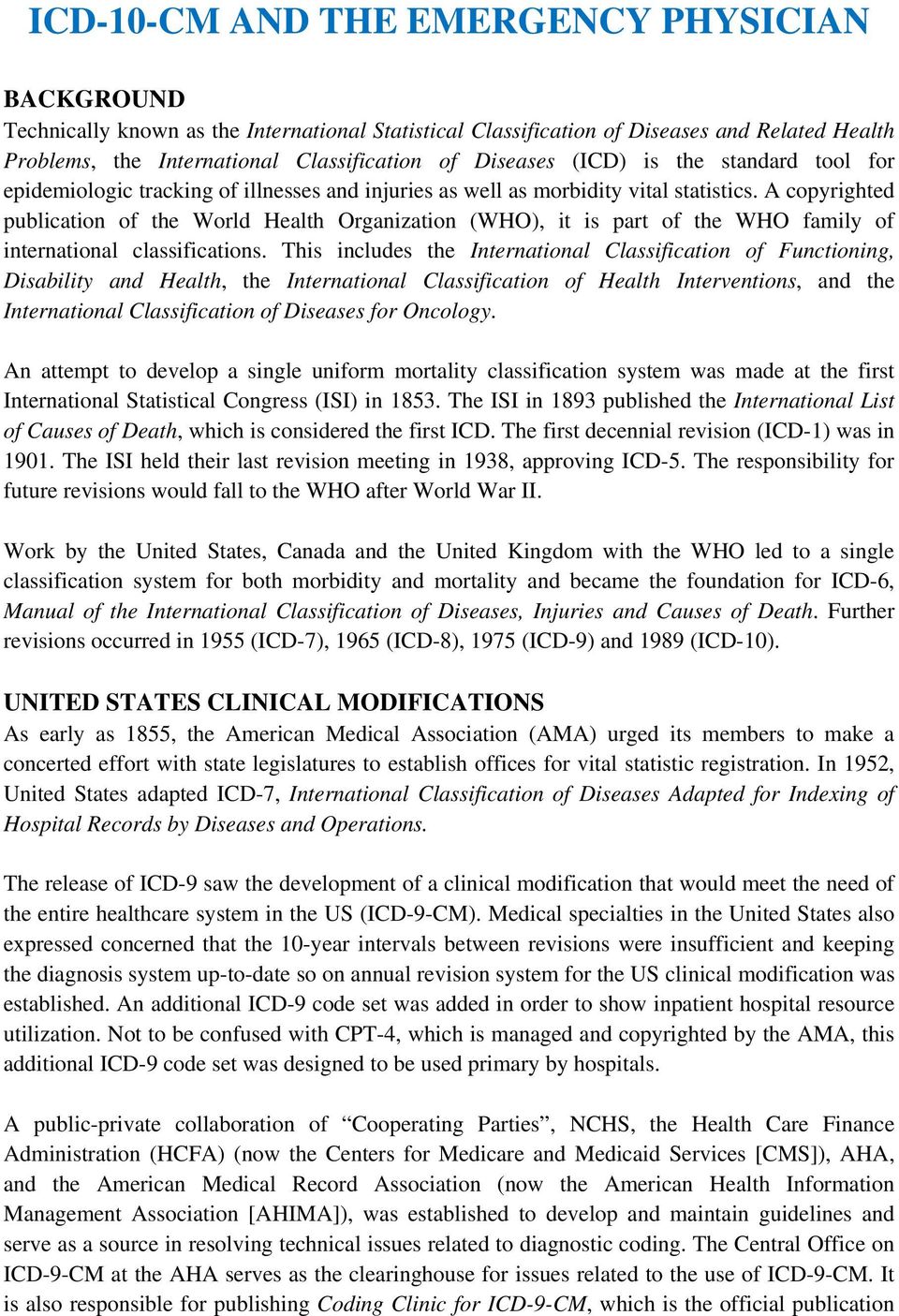
2 for ICD-9-CM coding guidelines and advice, as designated by the Cooperating Parties. This publication has been updated for ICD-10-CM, Coding Clinic for ICD-10. DEVELOPMENT OF ICD-10-CM In 1994, NCHS worked with the Center for Health Policy Studies to assess whether ICD-10 was a significant improvement over ICD-9-CM for morbidity reporting as well as make recommendations for improvements with the revised classifications. The evaluation showed that a clinical modification of the WHO version would be a significant improvement in is worth implementing. NCHS then undertook a three-phase development for ICD-10-CM. In Phase I public and private sector stakeholders reviewed the prototype system. In Phase II there were consultations with a number of medical societies, clinical coders and other stakeholders to assure clinical accuracy. Phase III included public review with submission of more than 1200 comments that resulted in further tweaking of the new system. Pilot testing by AHA and AHIMA was conducted in 2003 using a broad cross-section of the healthcare community with more than 180 participants. WHY CHANGE TO ICD-10-CM? ICD-9-CM is no longer robust enough to meet current and future health care needs. In the over 30 years that this classification system has been in place some of the content is no longer clinically accurate. There are structure limits that prevent the expansion to meet the new demands for new codes. Additionally, since more than 90 countries have switched to ICD-10 (some with local clinical modifications) and the United States has been using the system for reporting mortality data since 1999, it makes it difficult to compare state, national and international morbidity and mortality data. Moving to ICD-10-CM has several advantages. It uses current medical terminology and disease classification reflecting the advances that have occurred in medicine. It allows for greater specificity that can help in supporting clinical decision-making. There is greater flexibility with more room for expansion that can quickly incorporate emerging conditions. Comparison of morbidity and mortality data will be easier. The greater specificity will support improved public health surveillance and measurement of health care services with better quality metric measurements. This will help provide better data for research and in identifying fraud and abuse. STRUCTURAL DIFFERENCES BETWEEN ICD-9-CM AND ICD-10-CM ICD-9-CM contains 3 to 5 numerical placeholders, while ICD-10-CM contains 7 placeholders. In ICD-10-CM all codes are a combination of alpha and numeric placeholders containing between three and seven characters. The place holder X is used with codes that require a 7 th character but are less than six characters in length. ICD-10-CM code format and structure
3 INSTRUCTIONAL NOTES Exclusion notes: ICD-10-CM has two different types of excludes notes. The Excludes1 notation means that the two conditions cannot be coded together. For example, post-traumatic hydrocephalus (G91.3) would not be used in a patient with congenital hydrocephalus (Q03.9). The Excludes2 notation means that while the second condition is not part of the primary problem the two conditions may exist at the same time and it is acceptable to code them together. For example, a patient may be diagnosed with Streptococcal pharyngitis (J02.0) as well as uncomplicated Scarlet fever (A38.9) at the same time. Code First/Use Additional Code notes: A condition may have both an underlying cause and multiple manifestations. Coding convention requires when there is not a single code to explain this circumstance that the underlying condition (etiology) be listed or sequenced before any associated manifestations. The code first notation will be present with the manifestation and code additional with the etiology. For example, in a patient who presents to the ED with sepsis following a procedure, where the organism hasn t yet been identified, the etiology, post-procedural sepsis (T81.4 code set) would be coded first with the manifestation, sepsis of unspecified (unknown) organism (A41.9) listed as the additional code. In some cases, etiology and manifestations will have a single combination code; such as sickle cell SS disease with acute chest syndrome (D57.01). Code Also Note: Occasionally, two codes may be needed in order to fully describe a condition. In this situation there with is a code also note. The order that the codes are sequenced will depend on which condition the ED physician carries the greater risk of morbidity or mortality. For example, chronic pain due to trauma (G89.21) could also be coded as pain disorder with related psychological factors (F45.42). A dash - following a code indicates that additional characters are needed to fully identify the diagnosis. 7 TH CHARACTER: The seventh digit can be used for a variety of different purposes. This can range from an alpha character describing the stage of glaucoma or presence of tophi with gout, to a numeric character
4 identifying the affected fetus when there are problems associated with multiple gestations or the time/place when a coma score was obtained. The largest application of the 7 th character is with orthopedic conditions (see Figure 2). The codes will not only differentiate whether the fracture is open of closed on the initial encounter but uses the Gustilo classification in defining the severity of open fractures and identifies issues with fracture healing such as malunions and non-unions. The ED physician will generally only use two of the sixteen available 7 th character extensions (A, initial encounter for closed fracture, B, initial encounter for open fracture NOS). There are three 7 th characters that are used to identify the phase of care for injuries and external causes of morbidity: A (initial encounter), D (subsequent encounter), and S (sequel). An initial encounter is when the patient is receiving active care for injuries, fractures, burns, poisonings and similar conditions in the ED. This would be the majority of ED encounters. A subsequent encounter is used when a patient is receiving additional or routine care during the healing or recovery phase from an injury, fracture, burn, poisoning and similar condition. In the ED, this would include a cast change or medication adjustment. This designation would not be used if treatment is directed at a current acute disease or injury, even if the patient has already been seen for the condition in the same ED. The sequela encounter is similar to the late effect codes in ICD-9-CM and would only be used if the patient is being seen for a complication due to an injury, fracture, burn, poisoning or similar condition. In the ED, this would include management of a scar that was the result of a burn. The table below lists examples of the seventh character for fractures. Seventh digit codes for fractures A - initial encounter for closed fracture B - initial encounter for open fracture type I or II initial encounter for open fracture NOS C - initial encounter for open fracture type IIIA, IIIB, or IIIC D - subsequent encounter for closed fracture with routine healing E - subsequent encounter for open fracture type I or II with routine healing F - subsequent encounter for open fracture type IIIA, IIIB, or IIIC with routine healing G - subsequent encounter for closed fracture with delayed healing H - subsequent encounter for open fracture type I or II with delayed healing J - subsequent encounter for open fracture type IIIA, IIIB, or IIIC with delayed healing K - subsequent encounter for closed fracture with nonunion M - subsequent encounter for open fracture type I or II with nonunion N - subsequent encounter for open fracture type IIIA, IIIB, or IIIC with nonunion P - subsequent encounter for closed fracture with malunion Q - subsequent encounter for open fracture type I or II with malunion R - subsequent encounter for open fracture type IIIA, IIIB, or IIIC with malunion S - sequela TERMINOLOGY Just as with ICD-9-CM, ICD-10-CM does not require any new skills in documentation for the ED physician. Information such as laterality and episode of care should be able to be found in the documented history and physical. The use of appropriate terminology and supporting documentation will help support the medical necessity of the encounter and services provided.

5 Examples of charting details would include identifying: 1) why a patient has acute respiratory failure, e.g. acute respiratory failure due to hypercapnia (J96.02) ; 2) the mechanism and location of an injury, e.g. contusion of the left eye (S00.12XA) due to an altercation (Y04.0XXA) at high school (Y92.213) ; 3) the intent of an ingestion, e.g. intentional ingestion of acetaminophen (T39.1X2). The specifics of the fracture type have also been expanded. Now there will be unique codes indicating if the fracture is pathologic, traumatic or due to stress, transverse or spiral, displaced or non-displaced, just to name a few. Documentation as to the etiology and anatomic location is important. For example, a stress fracture of the thoracic vertebrae would be coded to M48.44XA, a pathologic shoulder fracture due to age-related osteoporosis to M80.08XA, and a wedge compression fracture of third thoracic vertebra to S Specifying the affected side in addition to the anatomic location is also important when appropriate. Documenting non-displaced transverse fracture of the shaft of the left radius and ulna (S52.325A, S52.225A) instead of forearm fracture (S52.90) will allow for more specific coding and identification of the injury. Infections such as cellulitis and abscesses also are identified by their anatomic location. The ED physician would document, for example, cutaneous abscess of left axilla (L02.412) instead of axillary abscess (L02.419). In ICD-9-CM the term open wound was used for lacerations, puncture wounds and bites, and complication included infected wounds, those with foreign bodies or with delayed care. ICD- 10-CM separates these terms so that the type of wound and complication are more easily identified. Where a puncture wound of the left forearm with a retained foreign body was coded as unspecified open wound of left forearm, (S51.802), there will be a unique code specifically identifying the injury as a puncture wound with foreign body of left forearm (S51.842A). The ED physician should be aware of the terms used to identify a septic patient. The terms septicemia and sepsis are often used interchangeably. In ICD-10-CM septicemia will code to sepsis of unspecified organism (A41.9). When known, the cause of sepsis should be identified, e.g. following vaccination, post-operative, after transfusion, as well as the organism. By convention, the term urosepsis translates to urinary tract infection (UTI). For a patient who is septic from a UTI, the ED physician needs to document that the patient is septic due to a UTI in order to have the proper codes identified (A41.9, N39.0). Severe sepsis is the term used for sepsis associated with organ dysfunction (R65.20) or severe sepsis with septic shock (R The underlying infectious agent should be coded first if known and any specific organ dysfunction coded additionally, e.g. acute kidney failure (N17 code set.), disseminated intravascular coagulopathy (DIC) (D65). The term systemic inflammatory response syndrome (SIRS) is used with septic-like conditions not due to an infection, such as heat stroke or trauma, with (R65.11) or without (R65.10) organ dysfunction. Bacteremia is not
6 sepsis ; it is a positive blood culture without any specific condition. Documentation needs to make the distinction between sepsis, severe sepsis, SIRS and bacteremia. ICD-10-CM allows for an expansion to identify encounters when there is a concern for a suspected condition or exposure without signs or symptoms that after evaluation and observation is not found (i.e. ruled out). Code Diagnosis Z03.6 Encounter for observation for suspected toxic effect from ingested substance ruled out Z04.1 Encounter for examination and observation following transport accident Z04.2 Encounter for examination and observation following work accident Z04.4- Encounter for examination and observation following alleged rape or sexual abuse Z20- Contact with and (suspected) exposure to communicable diseases Z77.0- Other contact with and (suspected) exposure to hazardous to chiefly non medicinal chemicals Table 1: Examples of ICD-10-CM codes for suspected conditions not found. CONCLUSIONS ICD-10-CM reflects advances in medicine and is more logically arranged to reflect anatomy, etiology and severity. Enhancements to the new code set include better reporting of lifestyle and socioeconomic issues, common manifestations and complications. By consistently documenting these key principles, healthcare data collection will be improved resulting in better reporting of services supporting the work performed. ICD-10-CM will be effective for all encounters starting October 1, All services provided before that date will continue to be reported with ICD-9-CM. In preparation, the ED physician should be looking at their available resources. This includes reviewing the electronic health record to verify that it is ICD-10-CM ready and what steps have to be taken to ensure it s updated. Verify that the billing software or service not only supports ICD-10-CM, but will be able to continue to report encounters prior to October 1 with ICD-9-CM. Make sure your billing clearing house is ready for the transition. Take steps now to encourage physicians to document and use more specific codes especially those who tend to use unspecified diagnosis codes or whose documentation leads to an unspecified code. Additional free resources, including the tabular code sets, indexes and tables are available from the National Center for Healthcare Statistics at REFERENCES ICD-10-CM Official Guidelines for Coding and Reporting, Accessed on December 18, 2013 at History of the development of the ICD. Accessed October 1, 2013 at
7 Moriyama IM, Loy RM, Robb-Smith AHT. History of the statistical classification of diseases and causes of death. Rosenberg HM, Hoyert DL, eds. Hyattsville, MD: National Center for Health Statistics Brooks P. ICD-10 Overview. Accessed October 1, 2014 at Contracting/ContractorLearningResources/downloads/ICD-10_Overview_Presentation.pdf
ICD-10-CM Chapters 18-21. January 16, 2014. Patricia Gowan, RHIA, CPC, AHIMA Approved ICD-10-CM/PCS Trainer
 ICD-10-CM Chapters 18-21 January 16, 2014 Patricia Gowan, RHIA, CPC, AHIMA Approved ICD-10-CM/PCS Trainer CHAPTER OVERVIEW Chapter 18 Symptoms, Signs and Abnormal Clinical & Laboratory Findings, NEC (R00-R99)
ICD-10-CM Official Guidelines for Coding and Reporting
 2013 Narrative changes appear in bold text Items underlined have been moved within the guidelines since the 2012 version Italics are used to indicate revisions to heading changes The Centers for Medicare
Introduction to ICD - 10. Andrea Devlin, CPMA, CPC Alta Partners, LLC 2015
 Introduction to ICD - 10 Andrea Devlin, CPMA, CPC Alta Partners, LLC 2015 Agenda Introduction Benefits of ICD-10 Features of ICD-10 ICD-9 vs. ICD-10 ICD-10 Structure Question & Answer Introducing ICD-10
ICD 10 CM: Presented by:
 ICD 10 CM: Presented by: ICD-10-CM Mission 2014 Why ICD-10? Mechanics of ICD-10 Why ICD-10? Why are we doing this? Here is an excerpt taken from the final ruling [T]he ICD-10 code sets provide a standard
Change is Coming in 2014! ICD-10 will replace ICD-9 for Diagnosis Coding
 Change is Coming in 2014! ICD-10 will replace ICD-9 for Diagnosis Coding Clinical Coding Diagnosis Codes Clinicians select ICD-CM codes to describe a patient s diagnoses, symptoms, and clinical findings.
Introduction to ICD-10-CM. An Introduction to the Transition from ICD-9-CM to ICD-10-CM
 Introduction to ICD-10-CM An Introduction to the Transition from ICD-9-CM to ICD-10-CM 1 Purpose Explain why the transition from ICD-9-CM to ICD- 10-CM is needed Describe the differences between ICD-9-CM
ICD-10 Coding for Audiology
 ICD-10 Coding for Audiology Mary Sue Fino-Szumski, Ph.D., M.B.A. Vanderbilt University School of Medicine Vanderbilt Bill Wilkerson Center Department of Hearing and Speech Sciences Disclosure Financial
Preparing for ICD-10. Preparing for ICD-10. Preparing for ICD-10
 Preparing for ICD-10: What You Should Be Doing Now PHCA November 11, 2014 Presented by: Reinsel Kuntz Lesher LLP Senior Living Services Consulting Stephanie Kessler, Partner Karin Sherman, Senior Consultant
ICD-10-CM: Training. Presented by: Anna M. Cruz CCS, CCS/P,CPC-A ICD10CM/PCS AHIMA Approved Trainer & Sonya Shebala CPC, CPC-H
 1 ICD-10-CM: Training Presented by: Anna M. Cruz CCS, CCS/P,CPC-A ICD10CM/PCS AHIMA Approved Trainer & Sonya Shebala CPC, CPC-H Partial Freeze of Revisions to ICD-9-CM and ICD-10-CM/PCS CDC.gov 2 October
Coding for ICD-10-CM: More of the Basics
 Centers for Medicare & Medicaid Services MLN Connects Video Transcript 12/1/14 Nguyen Intro Coding for ICD-10-CM: More of the Basics I am Nguyen, from the Provider Communications Group here at CMS. I would
TRANSITIONING FROM ICD-9 TO ICD-10 CODES PRESENTED OCTOBER 8, 2015 NATALIE RIVERA, RN, MS, BSN, CCM, CNLCP
 TRANSITIONING FROM ICD-9 TO ICD-10 CODES PRESENTED OCTOBER 8, 2015 NATALIE RIVERA, RN, MS, BSN, CCM, CNLCP ICD-10: INTERNATIONAL CLASSIFICATION OF DISEASES 10 TH REVISION International Classification of
Sarah Hanna President ECS Billing & Consulting North
 Presented By: Sarah Hanna President ECS Billing & Consulting North 252 W. Market St. Tiffin, Ohio 44883 419-448-5332 ext. 102 www.ecsbillingnorth.com [email protected] This presentation was
Getting Ready for ICD-10. Part 2: ICD-10 Coding
 Getting Ready for ICD-10 Part 2: ICD-10 Coding Introduction In the United States, on October 1, 2015 the ICD 9 code set used to report medical diagnoses and inpatient procedures will be replaced by International
Coding with. Snayhil Rana
 Coding with ICD-9-CM CM Snayhil Rana ICD-9-CM CM Index Pre-Test Introduction to ICD-9-CM Coding The Three Volumes of the ICD-9-CM ICD-9-CM Coding Conventions Other ICD-9-CM Sections ICD-9-CM for Claim
Guidelines Most Significantly Affected Under ICD-10-CM. May 29, 2013
 Guidelines Most Significantly Affected Under ICD-10-CM May 29, 2013 Guidelines Most Significantly Affected Under ICD-10-CM A look at the new system and how it compares to ICD-9-CM Presented by Therese
ICD-9 Basics Study Guide
 Board of Medical Specialty Coding ICD-9 Basics Study Guide for the Home Health ICD-9 Basic Competencies Examination Two Washingtonian Center 9737 Washingtonian Blvd., Ste. 100 Gaithersburg, MD 20878-7364
ICD-10-CM and ICD-10-PCS Frequently asked questions for HIM and Patient Financial Services Leaders
 ICD-10-CM and ICD-10-PCS Frequently asked questions for HIM and Patient Financial Services Leaders Executive questions What is the current status of ICD-10? The U.S. Department of Health and Human Services
ICD-10 FROM A NURSE PERSPECTIVE. Learning Objectives 4/22/2015. Adoption of ICD-10 Classification of Diseases CD-10-CM Diagnostic Codes
 ICD-10 FROM A NURSE PERSPECTIVE Learning Objectives 1. New ICD-10-CM diagnostic system for Dermatology. 2. Impact of new codes on nursing and clinical support staff. 3. Education and resources available.
ENGAGING PHYSICIANS FOR ICD-10: ALL ABOARD Engaging Physicians for ICD-10: All Aboard
 ENGAGING PHYSICIANS FOR ICD-10: ALL ABOARD Engaging Physicians for ICD-10: All Aboard ICD-10 Lisa Kozakoff Principal Consultant Siemens Healthcare Lisa Kozakoff Principal Consultant Agenda Introduction
ICD-10 IS COMING OCTOBER 1, 2014
 ICD-10 IS COMING OCTOBER 1, 2014 WHAT IS THE IMPACT ON THERAPY PRACTICES? CHET DESHMUKH, MBA, OTR/L, CPC, CHDA Overview Understanding the language of clinical diagnosis What is ICD? About ICD-9 CM Good
ICD 10 CM IMPLEMENTATION DATE OCT 1, 2015
 Presented by: Teri Romano, RN, MBA, CPC, CMDP ICD 10 CM IMPLEMENTATION DATE OCT 1, 2015 Source: http://journal.ahima.org/2015/02/04/us house committee to hold hearing on icd 10 implementation/ 2 2015 Web_Non
Breaking the Code: ICD-9-CM Coding in Details
 Breaking the Code: ICD-9-CM Coding in Details ICD-9-CM diagnosis codes are 3- to 5-digit codes used to describe the clinical reason for a patient s treatment. They do not describe the service performed,
ICD-10 Specified or Unspecified?
 206-478-8227 www.healthdataconsulting.com [email protected] ICD-10 Specified or Unspecified? Joseph C Nichols MD Principal The information provided in this whitepaper is the exclusive
Coding for ICD-10-CM: More of the Basics. December, 2014
 Coding for ICD-10-CM: More of the Basics December, 2014 How to Obtain a Code Book Free ICD-10-CM pdf ftp://ftp.cdc.gov/pub/health_statistics/nchs/publications/icd10cm/2015 Code books and associated tools
Common Pathology Diagnoses: ICD-9 to ICD-10 Mapping
 PERFORMANCE THAT MATTERS NUMBER OF CODES 14,000 69,000 ICD-9 DIAGNOSIS CODES ICD-10 DIAGNOSIS CODES CODE STRUCTURE ICD-9-CM CODE FORMAT ICD-10-CM CODE FORMAT X X X X X X X X X X X X CATEGORY ETIOLOGY,
How To Transition From Icd 9 To Icd 10
 ICD-10 FAQs for Doctors What is ICD-10? ICD-10 is the 10 th revision of the International Classification of Diseases (ICD), used by health care systems to report diagnoses and procedures for purposes of
2FORMATS AND CONVENTIONS
 2FORMATS AND CONVENTIONS OF DIAGNOSIS CODING SYSTEMS Learning Outcomes After completing this chapter, students should be able to 2.1 Explain the layout of the ICD-9-CM and ICD-10-CM manuals. 2.2 Differentiate
Getting Ready for ICD-10. Dianna Hoskins, OCS Cincinnati Eye Institute
 Dianna Hoskins, OCS Cincinnati Eye Institute Chart Documentation: Will your documentation stand up to ICD-10? Do you always mark which eye, severity or status of the disease (chronic or acute), site, etiology
SAMPLE. Anesthesia Services. An essential coding, billing, and reimbursement resource for anesthesiology and pain management ICD-10
 Coding and Payment Guide www.optumcoding.com Anesthesia Services An essential coding, billing, and reimbursement resource for anesthesiology and pain management 2017 a ICD10 A full suite of resources including
Transitioning from ICD-9-CM to ICD-10-CM. Tidewater Physicians Multispecialty Group Williamsburg, VA
 Transitioning from ICD-9-CM to ICD-10-CM Tidewater Physicians Multispecialty Group Williamsburg, VA February 22, 2014 Our Agenda Some guidelines for this morning s presentation Our Transformational Point
ICD-10-CM For Orthopedics. Lynn M. Anderanin, CPC, CPC-I, COSC, AHIMA ICD-10-CM Certified Trainer
 ICD-10-CM For Orthopedics Lynn M. Anderanin, CPC, CPC-I, COSC, AHIMA ICD-10-CM Certified Trainer Healthcare Information Services (HIS) HIS is a physician management company based in Chicago, IL specializing
ICD-10 CM & Audits Dr. Karen Walters Graduated: New York Chiropractic College in 1982 Chiropractic & Physical Therapy clinic for over 25 years
 ICD-10 CM & Audits Dr. Karen Walters Graduated: New York Chiropractic College in 1982 Chiropractic & Physical Therapy clinic for over 25 years Advised practice management consultants on setup & maintenance
ICD-10 FAQ. How Long Has ICD-9-CM Been In Use?
 ICD-10 FAQ How Long Has ICD-9-CM Been In Use? What Code Set Does ICD-9-CM Define? What Code Set Does ICD-10 Define? When was ICD-10-CM Created? What agency maintains ICD-10? Why is ICD-10 better than ICD-9?
Using the ICD-10-CM. The Alphabetic Index helps you determine which section to refer to in the Tabular List. It does not always provide the full code.
 Using the ICD-10-CM Selecting the Correct Code To determine the correct International Classification of Diseases, 10 Edition, Clinical Modification (ICD-10-CM) code, follow these two steps: Step 1: Look
CHAPTER 19 INJURY, POISONING AND CERTAIN OTHER CONSEQUENCES OF EXTERNAL CAUSES (S00-T88)
 INJURY, POISONING AND CERTAIN OTHER CONSEQUENCES OF EXTERNAL CAUSES (S00-T88) March 2014 2014 MVP Health Care, Inc. CHAPTER SPECIFIC CATEGORY CODE BLOCKS S00-S09 Injuries to the head S10-S19 Injuries to
Home Health Care ICD-10-CM Coding Tip Sheet Overview of Key Chapter Updates for Home Health Care and Top 20 codes
 Home Health Care ICD-10-CM Coding Tip Sheet Overview of Key Chapter Updates for Home Health Care and Top 20 codes Chapter 4: Endocrine, Nutritional and Metabolic Diseases (E00-E99) ICD-10-CM diabetes mellitus
ICD-9 and ICD-10 ORTHOPEDIC
 ICD-9 and ICD-10 ORTHOPEDIC Payers and Providers Partnering for Success Shannon Chase, CPC, AHIMA Approved ICD-10-CM/PCS Trainer July 2014 ICD-9 & ICD-10 - ORTHOPEDIC AGENDA Importance of Documentation
IRF Coding: Changing the Culture to Strengthen the Team
 IRF Coding: Changing the Culture to Strengthen the Team Stephanie Johnson, CCS Sr. HIM Coding Specialist 2014. The UDSMR logo is a trademark of, a division of UB Foundation Activities, Inc. Objectives
ICD-10 Provider Preparation
 ICD-10 Provider Preparation After browsing this slide deck, the viewer will become more familiar with the following information: What are the origins of ICD-10? Why transition to ICD-10? Why ICD-10 matters.
2/28/2013 ICD-10 AS MANDATED BY ACCME SPEAKERS ARE ASKED TO DISCLOSE ANY REAL OR APPARENT CONFLICT RELATED TO THE CONTENT OF THEIR PRESENTATION
 ICD-10 An Overview of the Code Sets with Emphasis on Documentation Requirements & Practice Readiness UMMC Family Medicine Update March 5-8, 2013 Flowood, Mississippi Patty Harper, RHIA AHIMA Approved ICD-CM/PCS
ICD 10: Final Steps for Successful Implementation
 ICD 10: Final Steps for Successful Implementation Gayle R. Lee, JD Matt Elrod, PT, DPT, MEd, NCS Presenters Gayle Lee, JD, has more than 15 years of experience working on health care issues impacting the
Where Are You on the ICD-10-CM Radar Screen? Presented to the Indiana Medical Group Management Association
 Where Are You on the ICD-10-CM Radar Screen? Presented to the Indiana Medical Group Management Association ICD-10 Final Rule On January 16, 2009, the U.S. Department of Health and Human Services (HHS)
ICD-10 for the Chiropractic Procrastinator
 ICD-10 for the Chiropractic Procrastinator Presented By Chiropractic Care of Minnesota, Inc. (CCMI) Authored By Dr. Evan Gwilliam, DC, MBA, BS, CPC, CCPC, NCICS, CCCPC, CPC-I, CPMA, MCS-P Introduction
Electronic Health Records Next Chapter: Best Practices, Checklists, and Guidelines ICD-10 and Small Practices April 30, 2014.
 Electronic Health Records Next Chapter: Best Practices, Checklists, and Guidelines ICD-10 and Small Practices April 30, 2014 Fallon Health Plan Christine Grondalski, Director Risk Adjustment & Analytics
Making the Transition: ICD-10-CM Diagnosis Codes ICD-10-CM: International Classification of Diseases, 10th Edition, Clinical Modification
 1 COA Fact Sheet Making the Transition: ICD-10-CM Diagnosis Codes ICD-10-CM: International Classification of Diseases, 10th Edition, Clinical Modification Mandated Transition to ICD-10 Codes: October 1,
International Classification of Diseases (ICD)-10: Are You Ready? Note! Contents are subject to change and are not a guarantee of payment.
 International Classification of Diseases (ICD)-10: Are You Ready? Note! Contents are subject to change and are not a guarantee of payment. Objectives Provider community ICD-10 compliance What you can expect
Preparing for ICD-10 WellStar Medical Group Toolkit
 Preparing for ICD-10 WellStar Medical Group Toolkit Preparing for ICD-10 On Oct. 1, 2015, WellStar will transition from ICD-9 to ICD-10 coding for all medical diagnoses and hospital procedures Systemwide.
The ICD-9-CM uses an indented format for ease in reference I10 I10 I10 I10. All information subject to change. 2013 1
 Section I. Conventions, general coding guidelines and chapter specific guidelines The conventions, general guidelines and chapter-specific guidelines are applicable to all health care settings unless otherwise
ICD-10 Transition Overview
 ICD-10 Transition Overview Donna Pickett, MPH, RHIA OSELS/National Center for Health Statistics Centers for Disease Control and Prevention U.S. Department of Health and Human Services Centers for Disease
10/23/2010. Objectives. Coding Process. What is ICD-9-CM coding? HCPCS. What is CPT-4? Provide a basic understanding of the coding process
 Objectives Medical Coding and Billing HCMT 200 Provide a basic understanding of the coding process Understand the importance of complete, accurate documentation to the coding process Learn the benefits
ICD-10 in the Provider Newsletter
 ICD-10 in the Provider Newsletter ICD-10 CM Code Structure, July 2013 ICD-10 Implementation, April 2013 ICD-10 Manual, January 2013 ICD-10 Back on Track, October 2012 ICD-10 Training, July 2012 ICD-10
Preparing for ICD-10. What Your Practice Needs to Know
 WRS Health Preparing for ICD-10 2 Executive Summary The healthcare industry is set to undergo an important change on October 1, 2014, when the mandatory adoption of the ICD-10 codes go into effect. The
ICD-10-CM Official Guidelines for Coding and Reporting FY 2016 Page 2 of 115
 Narrative changes appear in bold text Items underlined have been moved within the guidelines since the FY 2014 version Italics are used to indicate revisions to heading changes The Centers for Medicare
FAQ for Coding Encounters in ICD 10 CM
 FAQ for Coding Encounters in ICD 10 CM Topics: Encounter for Routine Health Exams Encounter for Vaccines Follow Up Encounters Coding for Injuries Encounter for Suture Removal External Cause Codes Tobacco
ASDIN 8th Annual Scientific Meeting
 WHO World Health Organization Developed in 1994 AN INITIAL UNDERSTANDING OF Sarah Reed, CPC Coding and Compliance Coordinator Meritas Health Corporation Implementation 138 countries mortality 99 countries
ICD-10: Navigating the Change. Presented by: Shelley Garrett, CPC, CMC, CMOM, CMIS
 ICD-10: Navigating the Change Presented by: Shelley Garrett, CPC, CMC, CMOM, CMIS A journey of a thousand miles begins with a single step -Confucius 5010 Conversion January 1, 2012 5010 Conversion Version
ICD 10 ICD 9. 14, 000 codes No laterality Limited severity parameters No placeholders 3-5 digits
 ICD 10 Conversion 1 Why Change? ICD 9 14, 000 codes No laterality Limited severity parameters No placeholders 3-5 digits 1 2 3 4 5 ICD 10 69,000+ codes Indicates Rt or Lt Extensive severity parameters
Understanding the ICD-10
 The Health Care Revenue Cycle Understanding the ICD-10 Robert A. Kaplan BA, DC, MBA, CPAT Doug Finney Copyright 2012, Finney Learning Systems, Inc., All Rights Reserved Understanding the ICD-10 A major
The Transition to Version 5010 and ICD-10
 The Transition to Version 5010 and ICD-10 An Overview Denise M. Buenning, MsM Director, Administrative Simplification Group Office of E-Health Standards and Services Centers for Medicare & Medicaid Services
ICD-10 Clinical Documentation Requirements
 ICD-10 Clinical Documentation Requirements Presented by: Joe Nichols MD Date: Dec 20, 2013 Agenda Getting beyond resistance Business Impacts Why is good documentation important? Getting from assessment
Preparing for ICD-10 Advance Preparation for Implementation Charles Brownlow, OD [email protected]
 Preparing for ICD-10 Advance Preparation for Implementation Charles Brownlow, OD [email protected] International Classification of Diseases (ICD-9, ICD-10) Both include codes for all medical conditions,
It s Time to Transition to ICD-10
 July 22, 2015 It s Time to Transition to ICD-10 What do the changes mean to your SNF? Presented by: Linda S. Little, RN-BSN Clinical Consultant HMM Consulting Office: (631) 265-6289 E-Mail: [email protected]
ICD-10 Transition & Implementation Information
 ICD-10 Transition & Implementation Information I ICD-10 Implementation Compliance Date: October 1, 2015 ICD-10-CM diagnoses codes will be used by all providers in every health care setting. ICD-10-PCS
ICD-10-CM/PCS Transition Fact Sheet
 ICD-10-CM/PCS Transition Fact Sheet Reed Group 10155 Westmoor Drive, Suite 210 Westminster, CO 80021 Notice: 2014 Reed Group, Ltd. All rights reserved. This document is made available for informational
Introduction to ICD-10: A Guide for Providers. Centers for Medicare & Medicaid Services
 Introduction to ICD-10: A Guide for Providers Centers for Medicare & Medicaid Services 1 Table of Contents Compliance Date: October 1, 2014» What is ICD-10?» Why ICD-10 matters» Why transition to ICD-10»
Basic ICD-10-CM Documentation and Coding. Effective date: October 1, 2015. Presented by: Jenna Glenn, CPC May 6, 2015 1
 Basic ICD-10-CM Documentation and Coding Effective date: October 1, 2015 Presented by: Jenna Glenn, CPC May 6, 2015 1 Objectives Overview on what is ICD-10-CM Changes from ICD-9-CM to ICD-10-CM Importance
ICD-10... What Are You Waiting For?
 ICD-10... What Are You Waiting For? What is it? International classification for all general epidemiological, many health management purposes, and clinical use Published by the World Health Organization
ICD-10-CM KEVIN SOLINSKY, CPC, CPC-I, CEDC, CEMC PRESIDENT HEALTHCARE CODING CONSULTANTS, LLC 480-200-4590
 ICD-10-CM KEVIN SOLINSKY, CPC, CPC-I, CEDC, CEMC PRESIDENT HEALTHCARE CODING CONSULTANTS, LLC 480-200-4590 ICD-10 FINAL RULE Implementation date October 1, 2014. ICD-9-CM codes will not be accepted by
ICD-9-CM Official Guidelines for Coding and Reporting Effective October 1, 2011 Page 2 of 107
 Narrative changes appear in bold text Items underlined have been moved within the guidelines since October 1, 2010 The Centers for Medicare and Medicaid Services (CMS) and the National Center for Health
ICD-9-CM Official Guidelines for Coding and Reporting
 Narrative changes appear in bold text Items underlined have been moved within the guidelines since April 2005 The guidelines include the updated V Code Table The Centers for Medicare and Medicaid Services
ICD 10: Implications For Content Conversion in Vendor Products
 ICD 10: Implications for Content Conversion in Vendor Products Ardith Campbell, CPC, CPC H, CCP Manager, Charge and Revenue Integrity Services MedAssets ICD 10: Implications for Content Conversion in Vendor
Title: Coding Documentation for IHS Affiliated Physician Practices
 Affiliated Physician Practices Effective Date: 11/03; Rev. 4/06, 7/08, 7/10 POLICY: IHS affiliated physician practices will code diagnoses utilizing the International Classification of Diseases, Ninth
ICD-10-CM Overview and Coding Guidelines. Presented by: Katherine Abel/Rhonda Buckholtz
 ICD-10-CM Overview and Coding Guidelines Presented by: Katherine Abel/Rhonda Buckholtz 1 No part of this presentation may be reproduced or transmitted in any form or by any means (graphically, electronically,
Welcome to ICD-10 CLINICAL CLOSE-UP
 Welcome to ICD-10 CLINICAL CLOSE-UP Topics ICD-10 Overview About ICD-10 Why ICD-10 Matters ICD-9 vs ICD-10 Clinical Close-Up ICD-10 Documentation GEMs Mapping Tool GEMS vs Coding Manual Bi-Directional
ICD-10-CM. Objectives
 ICD-10-CM What is it? Why? Now What? Debbie Johnson, RHIT, CHP American Health Care Association Webinar September 12, 2013 Objectives Learn what ICD-10-CM is what the main differences in ICD-9 and ICD-10
ICD-10 s and Ambulance Services
 ICD-10 s and Ambulance Services Medicare Regulatory Co-Chairs Angela Lehman, RHIA Emergency Medical Services Authority Rebecca Williamson, BA, RN, NRP Muskogee County EMS Overview The International Statistical
ICD-10 DRG Impacts at the Hospital Level
 A Health Data Consulting White Paper 1056 Ave S Edmonds, WA 98020-4035 206-478-8227 www.healthdataconsulting.com ICD-10 DRG Impacts at the Hospital Level Joseph C Nichols MD Principal 12 Nov 2011 TABLE
Celebrating ICD-10: A New Tradition of Codes.
 Celebrating ICD-10: A New Tradition of Codes. Delayed. Now What? Stop training entirely? Continue training as originally planned? Alter the course of training? Important Dates January 16, 2009 February
Getting Ready for ICD-10. Part 1: The Basics
 Getting Ready for ICD-10 Part 1: The Basics Introduction In the United States, on October 1, 2015 the ICD 9 code set used to report medical diagnoses and inpatient procedures will be replaced by the International
ICD-10 Spotlight: Know the codes
 Revised December 1, 2012 Independence Blue Cross offers products directly, through its subsidiaries Keystone Health Plan East and QCC Insurance Company, and with Highmark Blue Shield independent licensees
ICD-10: Prepare, Implement, and Train
 ICD-10: Prepare, Implement, and Train Source Medical Solutions, Inc. October 2013 For more information, please visit www.sourcemed.net or call 866-687-2300 1 Executive Summary There are numerous documents
ICD-10: 26 Tips You Absolutely Want to Know!
 ICD-10: 26 Tips You Absolutely Want to Know! ICD-10 The 10th edition of the International Classification of Diseases (ICD-10) is almost upon you! Chances are you've been preparing, but the magnitude of
The Official Guidelines for coding and reporting using ICD-9-CM
 Reporting Accurate Codes In the Era of Recovery Audit Contractor Reviews Sue Roehl, RHIT, CCS The Official Guidelines for coding and reporting using ICD-9-CM A set of rules that have been developed to
ICD-10 Transition: Challenges and Opportunities for the 21 st Century
 ICD-10 Transition: Challenges and Opportunities for the 21 st Century May 2015 The Montana Hospital Discharge Data System International Classification of Diseases (ICD) Statistical classification of diseases
A Comparison of ICD-10-CM and ICD-9-CM for Capturing Domestic Violence
 A Comparison of ICD-10-CM and ICD-9-CM for Capturing Domestic Violence Felicia Cohn, PhD William Rudman, PhD Travis Bankhead, BS Valerie Watzlaf, PhD, FAHIMA, RHIA Objectives Understand the differences
ICD-10-CM Official Guidelines for Coding and Reporting FY 2015 Page 2 of 116
 Narrative changes appear in bold text Items underlined have been moved within the guidelines since the FY 2014 version Italics are used to indicate revisions to heading changes The Centers for Medicare
DEPARTMENT OF HEALTH AND HUMAN SERVICES Centers for Medicare & Medicaid Services ICD-10-CM/PCS THE NEXT GENERATION OF CODING
 DEPARTMENT OF HEALTH AND HUMAN SERVICES Centers for Medicare & Medicaid Services ICD-10-CM/PCS THE NEXT GENERATION OF CODING ICN 901044 April 2013 This publication provides the following information on
ICD-10-CM Training Module for Dental Practitioners. Presented by Workgroup for Electronic Data Interchange
 ICD-10-CM Training Module for Dental Practitioners Presented by Workgroup for Electronic Data Interchange Disclaimer This presentation is for discussion and educational purposes only and is not intended
Certified Registered Nurse Anesthetist ICD-10-CM Coding Tip Sheet Overview of Key Chapter Updates for CRNA s and Top 25 Codes
 Certified Registered Nurse Anesthetist ICD-10-CM Coding Tip Sheet Overview of Key Chapter Updates for CRNA s and Top 25 Codes Chapter 2 Neoplasms (C00-D49) Classification improvements Code expansions Significant
Anthem Workers Compensation
 Anthem Workers Compensation ICD-10 Frequently Asked Questions What is ICD-10? International Classification of Diseases, 10th Revision (ICD-10) is a diagnostic and procedure coding system endorsed by the